

my first venice biennale !!!
during which I discover the Cynar spritz and see some good/bad art/outfits

Thursday, 08:15
Reading true crime about London’s oligarch underworld in my haunted hotel room. Tonight Emily and I will take photos on my incredible gold bed and a spirit orb will appear as a streak of light on my phone screen. Show yourself I will say, and the next picture will be Emily, wide-eyed, and a perfect white circle above her.
I am usually terrified in hotel rooms, especially dark, wonky-floored hotel rooms which remind me of The Yellow Wallpaper, but I am waking up in a strangely calm mood here. Perhaps it is the low-lying hangover from the five Cynar spritzes I drank last night.


I dress: a plain white t-shirt, capris (elevated basic), sweaty leather ballet heels which everybody told me not to wear here but as I replied to everybody, I do not wear trainers.. I am in the hotel’s annex, which is not really in the hotel at all, and my door opens into a shadowy alleyway in the backrooms of San Marco. I slip from my gaudy Venetian cell into a crowd of thick-accented, thick-waisted Americans. I spend €3.80 on a pistachio creme croissant and whole milk cappuccino and the man who serves it to me calls me princess, which for some reason feels more fatherly than creepy coming from an Italian.


This is my first time at the vernissage week of the Venice Biennale, and also my first time in Venice. At 3am on Wednesday I did not really feel like getting the 6am flight out of Heathrow and spending a week marooned in a vicinity whose only exit is through water with the entirety of the art world. I was quite tired. I am still quite tired, but I love it here. I love being called a princess and six euro cigarettes and rolling out of bed to beauty from all angles.
11:00
I am on the top floor of a lombardesque palazzo considering whether to get a tattoo reading радість, which is the Ukrainian word for joy. This is part of an artwork in the collateral exhibition comprising primarily Ukrainian artists that I am here to cover, hosted by the Kyiv-based PinchukArtCentre (you can read my coverage here). The exhibition is about radical happiness, and it is an inspiring antidote to much of the ostentatious crap populating the city this week. Hanging contemporary art in an ornate fifteenth century palace is a very easy way to weed out the bad stuff.
This palace is also unique, because it is not as shiny as, say, the Pinault Palazzo Grassi or the ACP–Palazzo Franchetti across the canal. It’s dark and a bit eccentric, like my hotel room. Once upon a time it was the home of Princess Polignac/ Winaretta Singer (heiress to the Singer sewing machine fortune) who held salons there with the likes of Stravinsky playing on one of the princess’s four prized pianos. But I digress – one thing I have discovered is that all Venetian buildings have somewhat fascinating histories.


In my commissioned piece, I did not write about my favourite artwork here, which is a video by the artist duo Roman Khimei and Yarema Malashchuk called Open World. Khimei and Malashchuk are known for their depictions of war mediated by modern technology. In this film they have adopted a military-use robo-dog to enable a boy exiled in Poland to remotely control its movement around his Ukrainian home town. At one point, robo-dog stares blankly at a real cat in a face-off. The boy pleads with his pet to recognise him, but there is an irreconcilable distance between them.
At the press preview, there are two Ukrainian soldiers in full uniform. One of them, Hlib Stryzhko, is a marine and a former prisoner of war. Their testimonies structure the exhibition, but many of the artists are also military personnel. The cinematographer Yuri Gruzinov tells me about an impromptu performance he staged within the Russia Pavilion the day before. Dressed in his Ukrainian special forces uniform, he listed the names of Russian participants down in a conspicuous red notebook. The work’s title roughly translates to something like Fucking Assholes (2026). Iconic !!!!
15:00


Legs hurting at the Arsenale. It takes me approximately twenty minutes to comprehend any art in the group exhibition at all, because adjusting from navigating (avoiding) a bustling crowd of vaguely familiar people to contemplating an exhibition whose premise is ‘spiritual and physical rest’ is surprisingly difficult.
The structure of the exhibition is also obfuscated, which would be ok if it was smaller, but is rather overwhelming when navigating vast warehouses containing the works of 111 artists. That being said, some of the art is genuinely amazing. The show markedly elevates the Global South – I really liked this review on Ocula by Zian Chen. I decide that I must return later in the year, sans crowds, to actually surrender myself to the exhibition’s non didactic logic.
Highlights include:
Kaloki Nyamai’s monumental hanging textile/paintings Kwata Kau, Ithyonze nitwavika vaa, and Ithyonze nitwavika vaa (2026).
Kader Attia’s Whispers of Traces (2026), a poetic, hallucinatory room fusing African ritual statues and modernism, with a shaman’s hypnotic words as the backdrop.
A quiet listening lounge dedicated to Pauline Oliveros’s Deep Listening, which – for the thirty seconds I wear its headphones – succeeds in calming me with its brain-massage melodies.
Alfredo Jaar’s dramatic red-light, chapel-like installation, which reaches its climax in a plain vitrine containing a small, glinting cube of precious materials: a shrine for Western economies.
Hagar Ophir’s ouija board evocation of colonial violence and the collective restitution of memory.
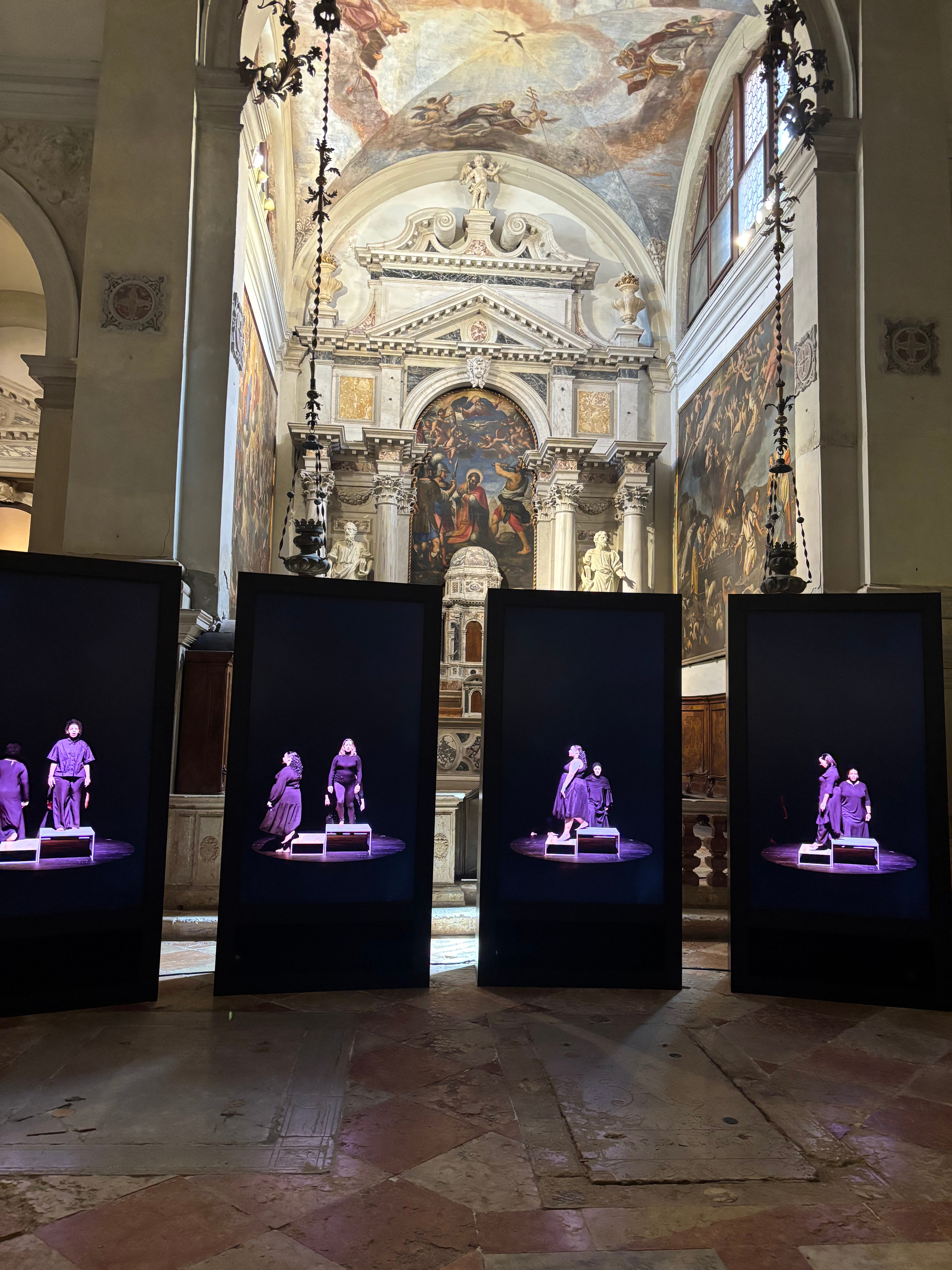
I also visit Gabrielle Goliath’s independent presentation of Elegy, staged in a stunning 4th century church. It is the perfect setting for a work of mourning requiring deep engagement. I find it much easier to lock in within this ecclesiastical space than the busy chaos of the shipyard. When I spoke to Goliath before the Biennale’s opening, she told me that “Sometimes protest can be as tender and beautiful as recalling a name”.
20:30


Dinner at Trattoria alla Madonna with Emily and Millen Brown-Ewens . I order Bigoli in salsa, despite our waiter’s protestations that I will not like it unless I am a seasoned pasta expert. I assure him that I love anchovies and onions because I am not a child and, sure enough, the pasta is delicious. Ever since I saw Nigella scoffing spaghetti at the River Cafe a few weeks ago I have decided (or am telling myself) that there is nothing sexier than saying fuck you to Ozempic culture and scoffing a load of carbs. Could I be a different kind of woman, to whom this thought doesn’t even occur? The kind of woman who ate carbs whether or not Nigella is the most beautiful woman in Britain or the gallerist I bumped into in the street said she hadn’t had a meal all day? Anyway. I also consume: a dubious looking but delicious artichoke heart, a bucket of homemade icecream, some wine, and of course, a Cynar spritz.
00:15
Later, at the BMW (x Preis der Nationalgalerie) party with Zander, taking turns to ambush the waiters/sailors who are serving champagne at infuriatingly irregular intervals. Funny speech from Klaus Biesenbach et al during which they refuse to give the microphone to Maurizio Cattelan, who cannot stay still and is wearing his sunglasses on his forehead. Finish with a drink in a dark alleyway before falling asleep to a book chapter on the Cipriani Five deaths in my regal bed.
Friday, 14:00
This is embarrassing. I spend the hours of 9:00–14:00 in one of three Venetian Starbucks, buying bottles of water for the Wifi code and a seat within plug socket reach. File my copy. Feel a bit dirty as I leave Starbucks, like I have committed Venetian sacrilege for being there, which I probably have.
16:30
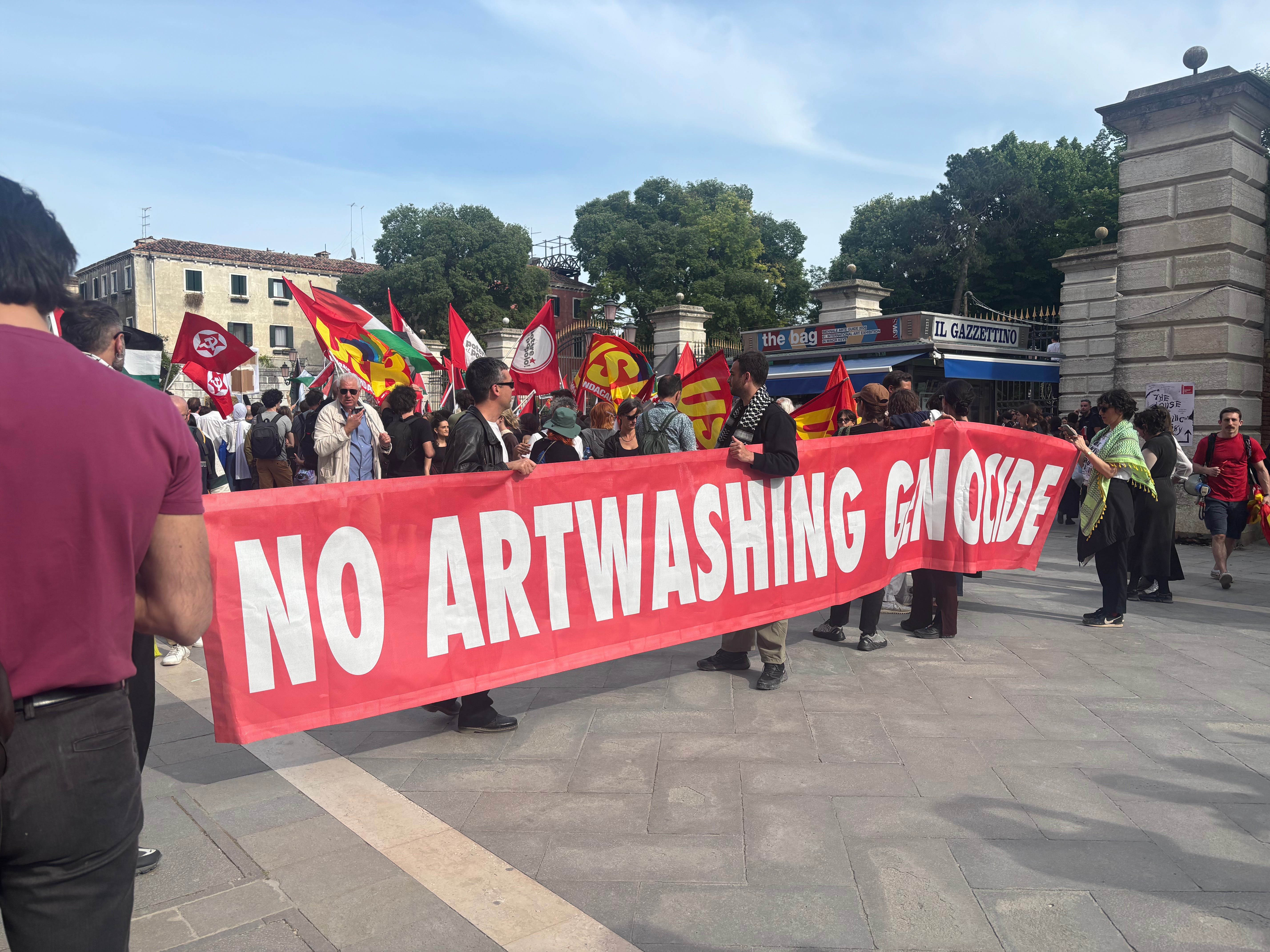
Emily and I join the Art Not Genocide Alliance strike/protest outside the Giardini. There has been a strange tension at the Biennale this year, between the atmosphere of celebration and indulgence which pervades big-budget drinks receptions and the ubiquitousness of the fondazione (as diagnosed by Janelle Zara ) and the armed guards standing outside the Israel and Russia Pavilions. At first I felt sorry for the girl at the entrance of Israel, greeting scowling onlookers with a smile, and then I remembered that she probably chose to be there.
The journalist Alex Marshall has posted a list on Instagram of closed Pavilions, which I will immortalise here for accountability:
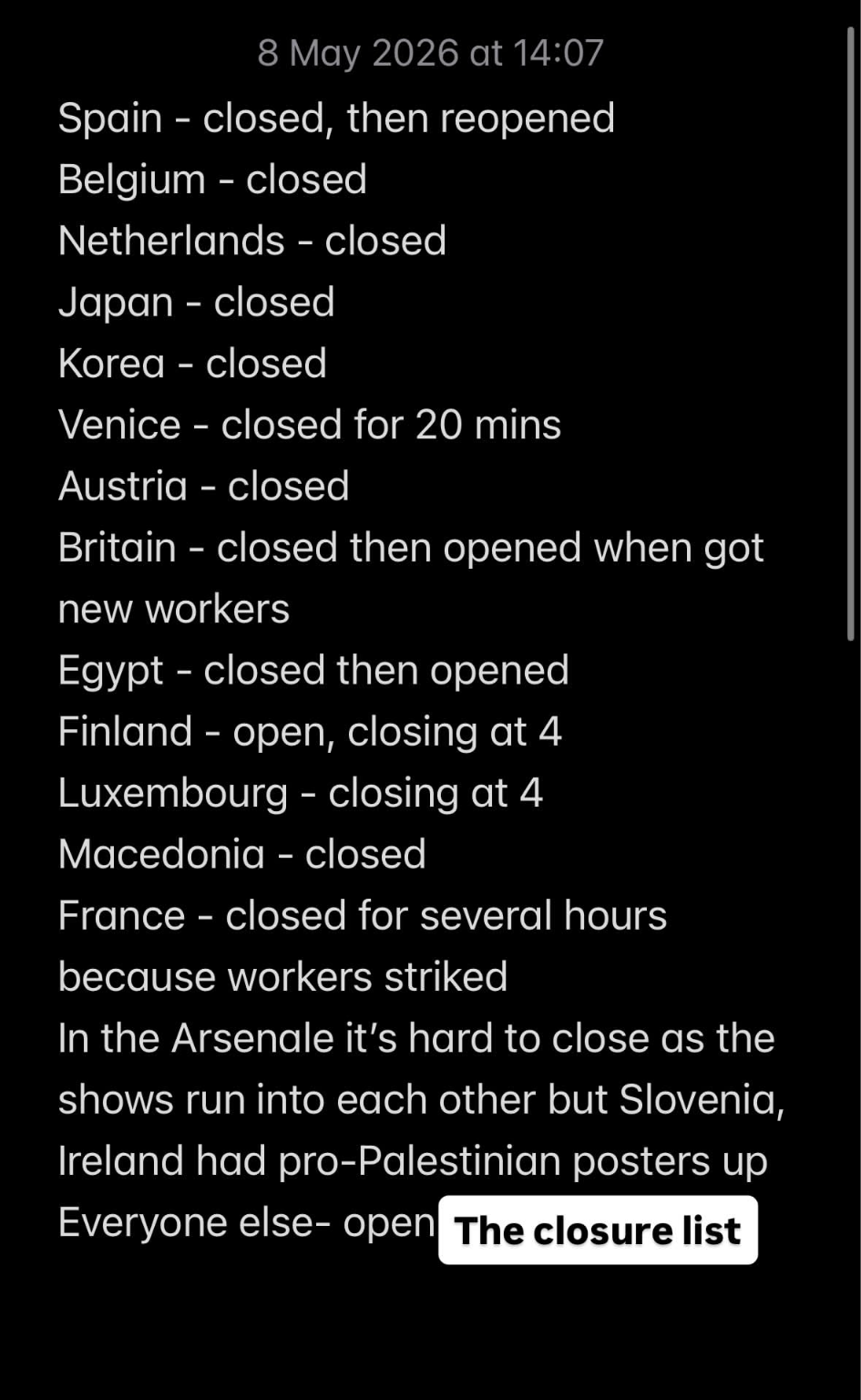
It’s easy to forget the violence and inequality that structures an industry ostensibly predicated on open expression and critical engagement, but the strike is a stark reminder. The familiar faces I bump into there or see participating via social media gives me some glimmer of hope.
20:15
I finish the day sharing a magnum of orange wine on the canal in Cannaregio with new friends and school friends, which I imagine is a lot more fun than the numerous events I am not invited to. More pasta, more cigarettes, dreamy. Venice at dusk is magical, the city has a romantic energy obscured by the bustling crowds at the height of the day.
Saturday, 11:00


After a failed attempt to access the Giardini due to my three-day press pass (I later learned that they’d have let me in anyway) I embark on a quick tour of collateral exhibitions. I am in a bad mood because of the local election results in London, so I decide to head only to shows that have been recommended to me, because there is nothing as depressing as bad art and nothing as inspiring as good.
My highlights:


At Palazzo Grassi, Michael Armitage is predictably incredible. His masterful use of colour lends highly political and often disturbing scenes an even more dramatic emotional resonance. He engages with mythology and hallucinatory dreamworlds in a way which escapes the too-often obfuscation these topics give rise to in contemporary art. My favourite painting is one titled #mydressmychoice (2015), a Rokeby Venus-styled portrait of a young woman attacked by a mob in Nairobi for wearing a miniskirt.


The Sanya Kantarovsky show is also very good. What seems to me to be dreamlike or cinematic images of a sinister boyhood reach their apex in a Murano glass sculpture of a boy’s head, which looks like it contains a spider. This kind of weird, uneasy art is my favourite, and it is a nice, subtle antidote to the flashiness of a lot of work displayed throughout the city.
19:30
Going home! Booooo.
On the Wizz Air flight to Luton, I bump into Olivia Allen , who looks very chic and professional with her quilted red Chanel bag, pencil skirt and suitcase. As for myself, less so. On the plane, the lady next to me orders the entire contents of the snack trolley and I try not to barf as I have a minor crisis about everything that I was unable to see during my brief trip. Alas, I must return in the near future. I am particularly upset about missing:
The Holy See Pavilion garden, and the Patti Smith performance at its inauguration (I wasn’t invited)
Björk performance (also not invited)
Arthur Jafa x Richard Prince at Prada. I did try and go to this, but it was towards the end of my stay and therefore I could not face another queue
Fondazione Dries Van Noten
Austria’s body-fluids-and-sewage waterpark (rumoured to be fake piss, fyi)
The ten people I said that I would go for drinks with and then got too overwhelmed to text back
Vernissage week suffers from the same predicament as an exhibition opening: its conditions are totally adverse to those best suited to viewing art. It is, however, a fascinating cross-section of both the artworld’s most vulgar traits and its most generative ones. For every farcical privately funded or propagandised display is a genuinely transformative one. For every war-mongering nation there is a group of people mobilising in resistance. I guess that, at the end of the day, it is all a reminder that events like this do not exist in a vacuum. We need the discourse, the press and the popular dissent that accompanies the exclusivity if we want to support the culture that facilitates our fairground week of fun. Violà!
Honorary mention for the earring ice cream launch